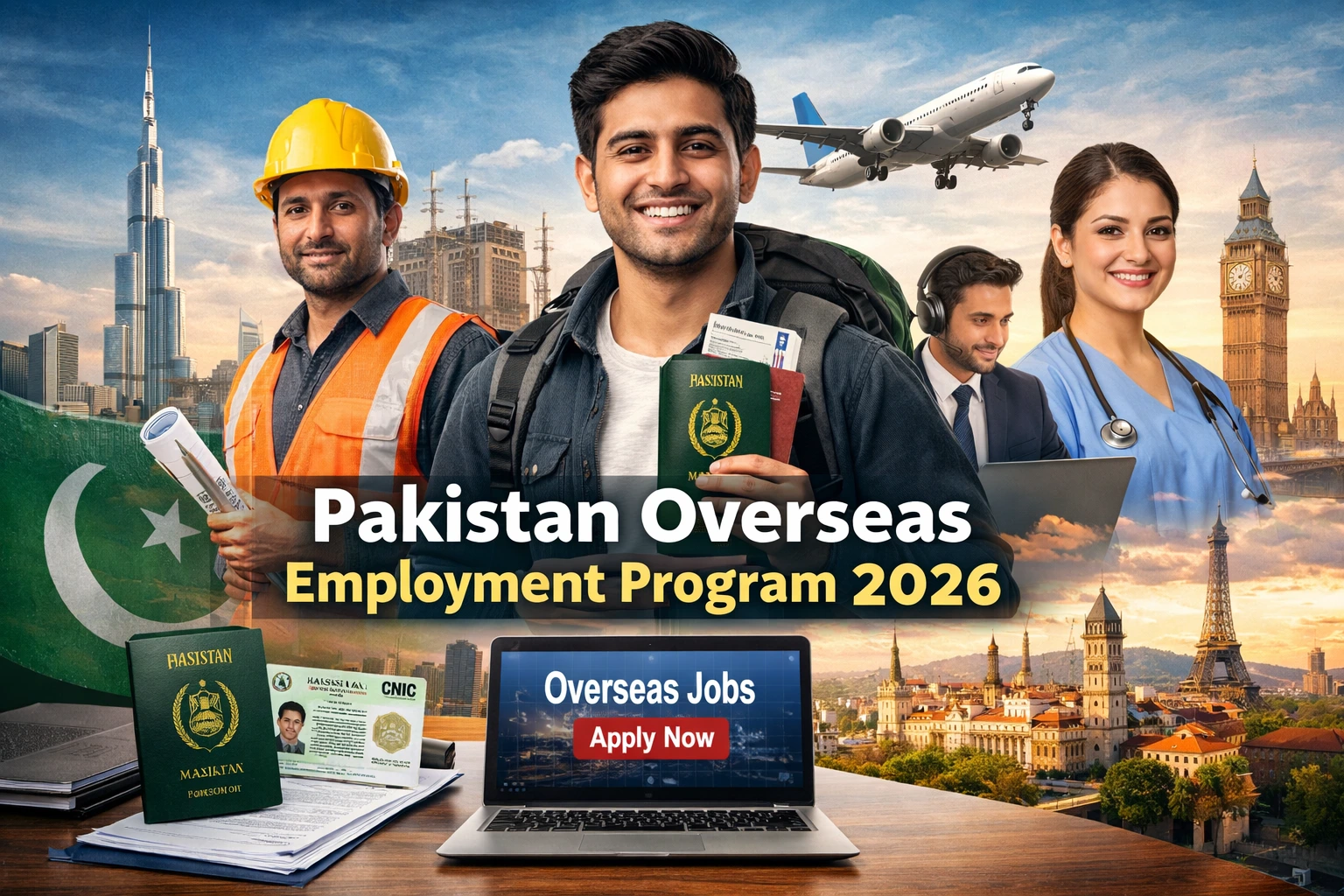
The Pakistan Overseas Employment Program 2026 is expected to play a major role in expanding global job opportunities for Pakistani workers. Overseas employment has long been a critical pillar of Pakistan’s economy, contributing billions of dollars in remittances every year. With increasing international demand for skilled and semi-skilled labor, the Government of Pakistan continues to strengthen its institutional framework to facilitate safe, transparent, and legal employment abroad.
This comprehensive guide by ReadInfos explains everything you need to know about the Pakistan Overseas Employment Program 2026, including objectives, eligibility criteria, application process, benefits, target countries, required documents, and important precautions for job seekers.
Introduction to Overseas Employment in Pakistan
For decades, millions of Pakistanis have worked abroad, particularly in Gulf countries such as Saudi Arabia, the United Arab Emirates, Qatar, Oman, and Kuwait. In recent years, opportunities have expanded to countries like Malaysia, South Korea, Japan, Germany, and other European states.
The Bureau of Emigration and Overseas Employment (BEOE) and the Overseas Employment Corporation (OEC) are the primary government bodies responsible for regulating and facilitating overseas employment. These institutions ensure that recruitment processes are legal, contracts are verified, and workers’ rights are protected.
The Pakistan Overseas Employment Program 2026 is designed to modernize and streamline this process, making it easier for Pakistani citizens to secure overseas jobs through official channels while reducing fraud and exploitation.
Objectives of the Pakistan Overseas Employment Program 2026
The program is structured around several key objectives:
1. Ensuring Safe and Legal Migration
One of the primary goals is to eliminate illegal recruitment practices and protect job seekers from fraudulent agents. By strengthening official recruitment channels, the government aims to ensure that all overseas employment contracts are verified and lawful.
2. Expanding Global Job Markets
The program seeks to explore new labor markets beyond traditional Gulf destinations. Efforts are being made to negotiate labor agreements with European and East Asian countries to increase the number of job opportunities for Pakistani workers.
3. Promoting Skilled Workforce Development
Another major objective is to enhance the skill level of Pakistani workers. Through technical training programs and certifications, the government aims to align local skills with international labor market requirements.
4. Increasing Remittances
Overseas Pakistani workers contribute significantly to the country’s foreign exchange reserves. By increasing the number of legally employed workers abroad, the government aims to strengthen economic stability through higher remittance inflows.
5. Providing Worker Protection and Support
The program emphasizes worker rights, contract transparency, and access to support services through Pakistani embassies and labor attachés in foreign countries.
Target Employment Sectors in 2026
The Pakistan Overseas Employment Program 2026 focuses on sectors where international demand for labor remains strong. These include:
Construction and Infrastructure
Skilled and semi-skilled workers such as masons, electricians, plumbers, steel fixers, carpenters, and heavy machinery operators continue to be in demand, particularly in Gulf countries.
Healthcare
Nurses, doctors, medical technicians, and caregivers are increasingly sought after in countries facing healthcare workforce shortages.
Information Technology
With global digital transformation, IT professionals including software developers, cybersecurity experts, data analysts, and network engineers have growing opportunities in Europe and Asia.
Engineering and Technical Fields
Mechanical, electrical, and civil engineers, along with technical supervisors, are regularly recruited for international projects.
Hospitality and Services
Hotels, restaurants, and tourism industries in various countries require chefs, waiters, cleaners, and front-desk staff.
Manufacturing and Industrial Work
Factory workers, machine operators, welders, and technicians are also in high demand in certain regions.
Eligibility Criteria for Applicants
Eligibility requirements vary depending on the specific job and destination country. However, general criteria typically include:
- Pakistani citizenship with a valid Computerized National Identity Card (CNIC)
- Valid passport
- Minimum age requirement, usually 18 years or older
- Educational or technical qualifications relevant to the job
- Relevant work experience where required
- Medical fitness certificate from an authorized medical center
- Police clearance certificate
For highly skilled positions, additional certifications or language proficiency may be required.
Required Documents
Applicants typically need the following documents:
- Valid passport
- CNIC copy
- Recent passport-sized photographs
- Updated CV or resume
- Educational certificates
- Technical diplomas or trade certificates
- Experience letters
- Medical fitness report
- Police clearance certificate
- Job offer letter or demand letter (verified)
All documents must be authentic and properly attested where necessary.
Application Process for Overseas Employment
The Pakistan Overseas Employment Program 2026 emphasizes the use of official government channels. Below is a step-by-step overview of the application process:
Step 1: Search for Verified Job Opportunities
Applicants should visit official websites such as:
- Bureau of Emigration and Overseas Employment (BEOE)
- Overseas Employment Corporation (OEC)
These portals publish verified job listings from approved foreign employers.
Step 2: Registration
Candidates must create an account on the relevant portal and provide accurate personal and professional details.
Step 3: Submit Application
Applicants can apply online for specific job vacancies by uploading required documents and paying any official processing fees.
Step 4: Interview and Selection
Shortlisted candidates may be called for interviews, either online or in person. Employers or authorized representatives conduct these interviews.
Step 5: Medical Examination and Documentation
Selected candidates must undergo a medical examination at an approved medical center. Visa processing and contract verification follow.
Step 6: Emigration Clearance
Before departure, candidates must obtain emigration clearance from the Protector of Emigrants office.
Step 7: Pre-Departure Orientation
In some cases, candidates are required to attend orientation sessions covering workers’ rights, cultural awareness, and safety guidelines.
Role of Government Institutions
Several government bodies play a crucial role in implementing the Pakistan Overseas Employment Program 2026.
Bureau of Emigration and Overseas Employment (BEOE)
BEOE regulates overseas employment and ensures that recruitment agents comply with legal standards. It also maintains data on emigrants and labor market trends.
Overseas Employment Corporation (OEC)
OEC operates as a government recruitment agency, directly connecting Pakistani workers with foreign employers.
Protector of Emigrants Offices
These offices provide emigration clearance and ensure all documents and contracts are verified before departure.
Benefits of the Program
The Pakistan Overseas Employment Program 2026 offers multiple benefits for job seekers:
Legal Protection
Workers recruited through official channels are protected by bilateral labor agreements and international labor laws.
Reduced Risk of Fraud
Government verification reduces the chances of falling victim to fake job offers or illegal recruitment agents.
Transparent Contracts
Employment contracts are reviewed and verified to ensure clarity regarding salary, working hours, accommodation, and other benefits.
Access to Support Services
Pakistani embassies and labor wings provide assistance in case of disputes or emergencies abroad.
Career Advancement
International work experience enhances professional skills and improves future career prospects.
Target Countries for 2026
While Gulf countries remain major destinations, the Pakistan Overseas Employment Program 2026 aims to diversify employment markets.
Gulf Region
- Saudi Arabia
- United Arab Emirates
- Qatar
- Oman
- Kuwait
- Bahrain
East Asia
- South Korea
- Japan
- Malaysia
Europe
- Germany
- Romania
- Poland
- Hungary
Other Regions
Opportunities may also arise in Canada and Australia under specific skilled migration pathways.
Common Challenges and How to Avoid Them
Despite government efforts, job seekers must remain cautious.
Avoid Unregistered Agents
Always verify whether a recruitment agent is licensed by the Bureau of Emigration and Overseas Employment.
Verify Job Offers
Do not rely solely on social media advertisements. Cross-check job offers on official government portals.
Do Not Pay Excessive Fees
Only pay officially approved fees and obtain receipts for all transactions.
Understand Your Contract
Carefully read the employment contract before signing. Seek clarification if necessary.
Training and Skill Development Initiatives
To improve global competitiveness, Pakistan is focusing on vocational training through institutions such as:
- Technical Education and Vocational Training Authority (TEVTA)
- National Vocational and Technical Training Commission (NAVTTC)
Skill certification aligned with international standards increases the chances of securing higher-paying jobs abroad.
Language training, especially in English, Arabic, Japanese, and Korean, is also becoming increasingly important.
Economic Impact of Overseas Employment
Overseas workers are among Pakistan’s largest sources of foreign exchange. Remittances contribute significantly to:
- Stabilizing the national currency
- Supporting families through improved living standards
- Reducing unemployment pressures
- Encouraging investment in local businesses
The Pakistan Overseas Employment Program 2026 aims to strengthen this contribution by increasing the number of workers sent abroad through legal and transparent channels.
Future Outlook
The global labor market is evolving rapidly. Countries facing labor shortages are actively seeking foreign workers. Pakistan, with its young population and expanding skilled workforce, is well-positioned to meet this demand.
Digitalization of recruitment systems, biometric verification, and data-driven labor market analysis are expected to improve efficiency and transparency in 2026.
With stronger bilateral agreements and better training infrastructure, Pakistan aims to enhance its reputation as a reliable source of skilled labor.
Conclusion
The Pakistan Overseas Employment Program 2026 represents a significant opportunity for Pakistani job seekers aiming to build careers abroad. By promoting safe, transparent, and legal recruitment processes, the government seeks to protect workers while expanding access to global job markets.
Applicants are encouraged to use official channels, verify job offers, and complete all documentation requirements carefully. With proper preparation, skill development, and awareness, overseas employment can provide financial stability, career growth, and valuable international experience.
As global labor demand continues to rise, 2026 may prove to be a transformative year for Pakistan’s overseas workforce. Staying informed and following official procedures will be key to successfully benefiting from this program.
For more updates and detailed guides, stay connected with ReadInfos.